Md. Rowshan Alam, Sirajganj Correspondent
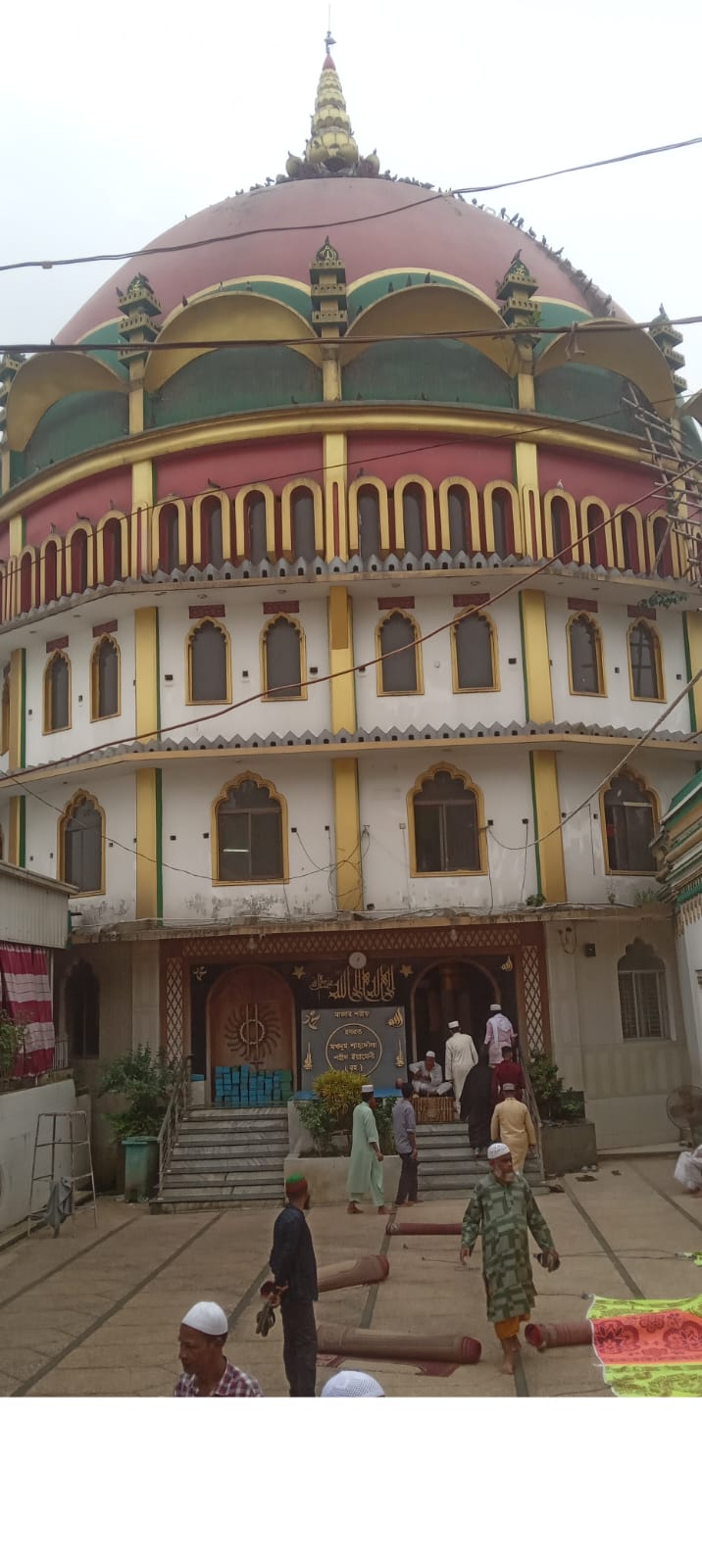
The historic Makhdumia Jame Masjid and shrine complex in Shahzadpur, Sirajganj, stands as an important centre of Islamic heritage and spiritual tradition in northern Bangladesh.
The mosque is associated with Hazrat Makhdoom Shahdaula Shaheed Yemeni (RA), who, according to local tradition, came to the region from Yemen in the late 12th century to spread Islam. He is believed to have been a descendant of Hazrat Muaz Ibn Jabal (RA), a prominent companion of Prophet Muhammad (PBUH) and a former governor of Yemen.
Historic mosque
The Shahzadpur Mosque is believed to have been built in the 11th century. It is regarded as one of the notable examples of Sultanate-era architecture in Bengal.
The mosque measures 51 feet 9 inches in length, 31 feet 5 inches in width and 16 feet 2 inches in height internally. Externally, it measures 62 feet 9 inches in length, 41 feet 9.5 inches in width and 19 feet 10 inches in height. Its walls are about 5 feet 7 inches thick.
The structure has five entrances, each measuring about 7 feet 5 inches in height and 6 feet 3.5 inches in width. It has 15 domes and is supported by 24 black stone pillars. Built mainly of brick, lime and mud, the mosque has survived for centuries beside the Karatoya River.
The structure is now known as Makhdumia Jame Masjid.
A legacy of Shahdaula (RA)
According to local accounts, Hazrat Makhdoom Shahdaula Shaheed Yemeni (RA) travelled from Yemen between 1192 and 1196 and spent some time at the shrine of Hazrat Jalaluddin Bukhari (RA) in Bukhara before travelling to Bengal.
Legend has it that Hazrat Jalaluddin Bukhari (RA) gave him a pair of pigeons, known locally as Jalali pigeons, before his departure.
After arriving in Bengal, Shahdaula (RA) began preaching Islam in the region. The then Hindu ruler of Suba Bihar, Raja Bikram Kesari, reportedly viewed his activities as a threat and sent troops against him.
According to the tradition, several battles took place between Shahdaula’s followers and the king’s forces, with the latter being defeated. Shahdaula (RA) continued preaching Islam across a large area around present-day Shahzadpur.
He was eventually martyred along with many of his companions in a final battle. It was after his martyrdom that he became known as Hazrat Makhdoom Shahdaula Shaheed Yemeni (RA).
One of the most prominent legends surrounding his martyrdom says that his head was severed while he was offering Asr prayers. His head was reportedly taken to Mahalkot in Mangalkot, the capital of Suba Bihar.
According to the legend, the severed head miraculously continued to recite Subhana Rabbiyal A’la. Witnessing the incident, the king’s commander-in-chief is said to have embraced Islam. The king subsequently ordered local Muslims to bury Shahdaula’s head. The site is still known locally as Cher Mokam.
His body, meanwhile, was buried in Shahzadpur, south of the mosque, and was later moved to its present resting place.
A centre of spiritual heritage
Shahdaula’s shrine is regarded by devotees as an important spiritual site. The complex also contains the shrines of several of his companions and other revered Islamic figures, including Hazrat Khazanur (RA), Hazrat Yusuf Shah (RA) and Hazrat Shah Shamsuddin Tabrezi (RA).
A site known as Badalbari, located across the Karatoya River to the east-south of the mosque, is also associated with Shahdaula (RA). Local tradition holds that several other graves and sacred sites were eventually lost to river erosion.
Hazrat Yusuf Shah (RA), one of Shahdaula’s companions, is also believed to have later ruled the Ettawa region, which is associated with the name Yusuf Shahi Pargana.
Annual Urs draws devotees
The annual Urs Sharif of Hazrat Makhdoom Shahdaula Shaheed Yemeni (RA) is held every year on Thursday and Friday during the second week of Chaitra. The Urs of Hazrat Shah Shamsuddin Tabrezi (RA), regarded by devotees as a spiritual teacher of Shahdaula (RA), is observed on 9 Rajab.
Millions of devotees from different parts of Bangladesh and abroad reportedly gather at the shrine during the annual observances.
With its centuries-old mosque, shrine, legends and continuing religious traditions, Shahzadpur remains an important part of Bangladesh’s Islamic and architectural heritage.