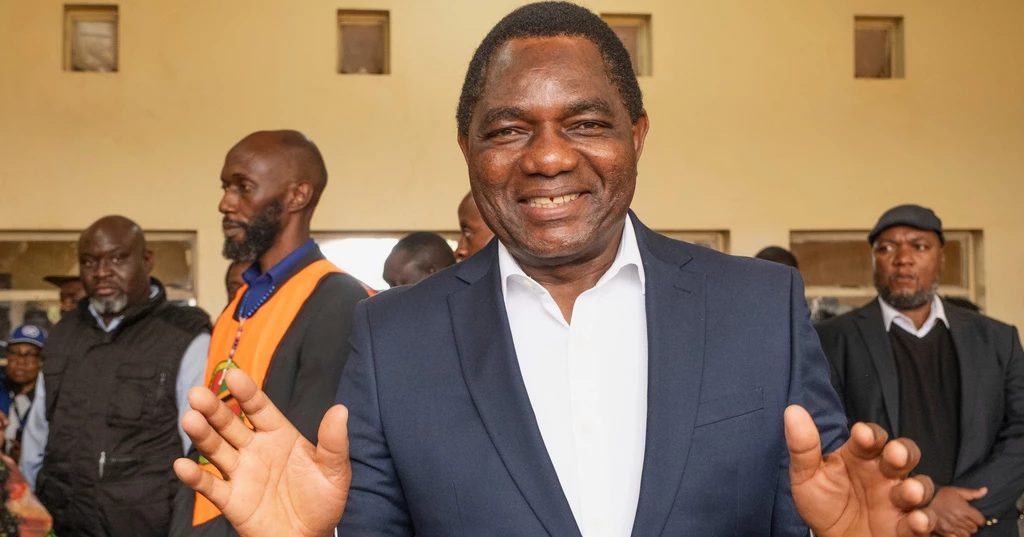
Intl desk: Zambian President Hakainde Hichilema has been reelected for a second five-year term, the Electoral Commission of Zambia announced early Tuesday.
Hichilema was declared the outright winner of last Thursday’s presidential election after securing 61.4% of the nearly 5 million votes cast, eliminating the need for a runoff.
According to the commission, Hichilema received 2,965,326 votes, while his closest rival, opposition leader Brian Mundubile, secured 1,856,217 votes, or about 38% of the total.
“I therefore declare, Hichilema Hakainde S, to be president-elect of the Republic of Zambia this 18th day of August, 2026,” commission chairperson Mwangala Zaloumis said, reports AP.
In a statement Tuesday, Hichilema welcomed the results and thanked Zambians for giving him another term. He also extended a message to those who supported the opposition.
“To those citizens who preferred the ideas presented by our opponents, we hear you, and we will continue to work for you to ensure that every Zambian benefits from the development we are delivering,” he said.
There was no immediate reaction from Mundubile.
Hichilema’s victory came after a closely watched election in which vote counting was suspended Friday and resumed several hours later under heightened security. The commission said some polling station officials had been attacked and ballot papers stolen.
The government also confirmed that several prominent opposition figures were arrested on election night, with police accusing them of posing a threat to state security.
Mundubile said police raided his home in what he described as an attempt on his life.
The election was widely viewed as a test of Hichilema’s economic recovery efforts after Zambia, a copper-rich country, was plunged into a debt crisis in 2020. Hichilema was first elected in 2021 and oversaw the restructuring of the country’s sovereign debt while reducing inflation and helping stabilize the currency.
International observers, including the European Union, said the election was largely peaceful but noted that the wider electoral process took place in an environment that restricted fundamental freedoms.
“Late legal changes, legal uncertainty, and unequal campaign conditions distorted the playing field,” said Michael McNamara, head of the EU election observation mission.
In a pastoral statement, the Zambia Conference of Catholic Bishops also raised concerns over the deployment of the army during the vote-counting process.
“The maintenance of order during elections is constitutionally and statutorily the responsibility of the Zambia Police Service,” the bishops said.