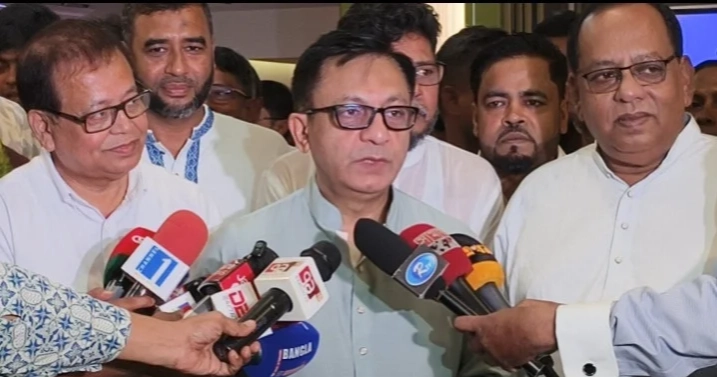
Dhaka: It may take around two years to build the necessary infrastructure to permanently address the country’s ongoing gas and electricity crises, Industries, Commerce, Jute and Textiles Minister Khandaker Abdul Muktadir said on Saturday.
He made the remarks while talking to journalists after a district-level workshop on formulating the annual work plan for the 2026-27 fiscal year and reviewing the implementation of the previous year under the Sylhet Region Agricultural Development Project through modern technology.
The workshop was held at a hall in Sylhet on Saturday afternoon.
“It will take about two years to resolve the problems and build the necessary infrastructure, including setting up a new FSRU (floating storage and regasification unit) and laying pipelines,” the commerce minister said.
He said the government has taken new initiatives to address the gas crisis beyond the conventional system.
Under the new initiative, LNG will be brought in large vessels through the relevant agencies of the Malaysian government, transferred to smaller vessels and then converted into gas through a floating regasification unit before being supplied to different areas, he said.
The minister, however, said there are some limitations, as additional vessels are not currently available because Petronas ships are engaged in various operations.
He said the Energy Ministry, under the leadership of Prime Minister Tarique Rahman, along with all relevant agencies, is working to address the situation.
Acknowledging the impact of the gas and electricity crisis on industries and households, Muktadir said, “Industries are suffering and normal life in homes is being disrupted. Everything is correct. However, the situation we have inherited is something everyone should understand.”
He said demand for gas and electricity varies by season, with electricity demand currently high because of the hot weather. Demand usually falls significantly during winter.
Explaining the recent deterioration in the situation, the minister said one of the country’s two floating LNG regasification units could not be supplied with gas, while a boiler at the other unit broke down in the past five to 10 days.
He said gas supply to one of the units has already resumed and the impact is becoming visible as the situation improves.
A boiler at the other unit has also been repaired, while work is underway to fix another one, he said.
“Once that is fixed, both units will be able to supply gas at full capacity. Then the situation will return to what it was about a month ago, and the ongoing disruption to power supply for industries will also be reduced significantly,” Muktadir said.
He said increasing the capacity of fuel terminals and drilling new wells would help the country become more self-sufficient, although completing such initiatives would take about two years.
According to the minister, the country’s daily demand for fuel is currently about twice the available supply, while demand is also higher during this time of year.
“That is why the crisis has become more visible,” he said.