Desk report: The European Union (EU) and its two member states – Spain and the Netherlands – have highlighted Bangladesh’s growing potential to become a regional leader in the circular economy and green shipbuilding.
As Bangladesh seeks to diversify its economy beyond the readymade garment sector, both sides believe that green manufacturing, recycling, and modern shipbuilding could become key pillars of the country’s next chapter of economic growth.
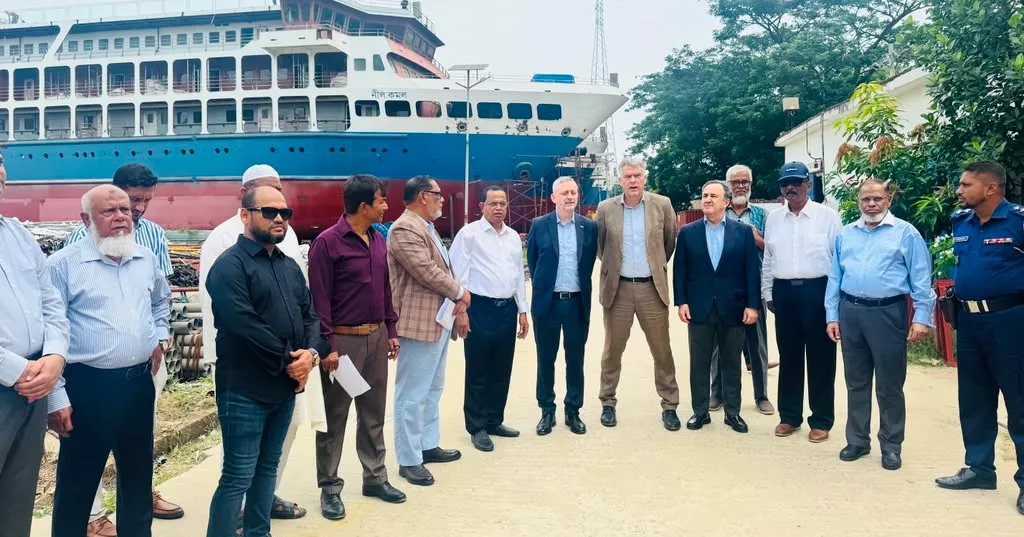
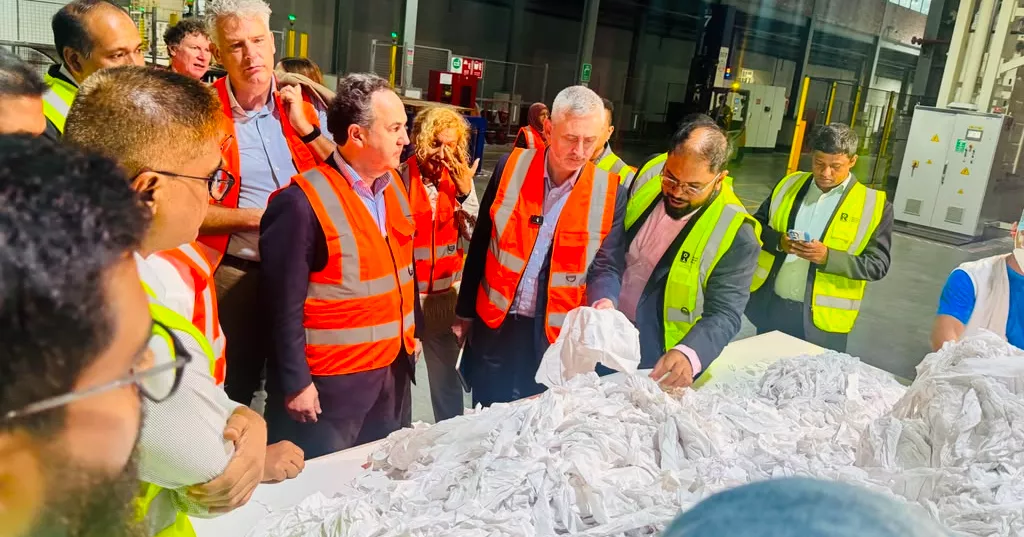
Ambassador and Head of the Delegation of the EU to Bangladesh Michael Miller, Netherlands’ Ambassador to Bangladesh Joris van Bommel, and Ambassador of Spain to Bangladesh Gabriel Maria Sistiaga Ochoa de Chinchetru witnessed several examples of Bangladesh’s industrial transformation during a visit to key industrial facilities.
They visited world’s largest and most modern cotton recycling plant (Recover), the country’s oldest shipbuilding dockyard (Dockyard and Engineering Works Limited, Bangladesh Navy), and one of Bangladesh’s largest private shipyards (Karnaphuli Ship Builders Ltd).
The Ambassadors said these achievements demonstrate how European technology and market access can combine with Bangladeshi entrepreneurship to produce globally competitive industries.
“This is great. The sector holds huge potential. Bangladesh’s economy needs to modernise and diversify, and the European Union, together with our member states, wants to be part of your future success story. We are here with an incredibly positive agenda,” EU Ambassador Miller told UNB after visiting Karnaphuli Ship Builders Ltd in Narayanganj this week.
He highlighted how European capital, expertise, and technology can be matched with Bangladeshi entrepreneurship to make this a future success story.
Dutch envoy Bommel said, “We’re here to understand and to see, in line with the long-standing relationship that we have. So, for the Netherlands, for our embassy here in Dhaka, collaboration in the maritime sector between the Netherlands and Bangladesh is a priority.”
He laid emphasis on working together to find innovative solutions for building better ships with improved designs, while also collaborating in the future to green the shipbuilding industry.
The Dutch envoy said they are looking forward to strengthening business-to-business, knowledge-to-knowledge, and government-to-government cooperation, and to deepening collaboration with Bangladesh’s maritime sector.
The EU sees Bangladesh as having enormous potential to become a regional recycling hub, creating new industries while supporting Europe’s own sustainability goals.
The three ambassadors emphasised that Bangladesh’s transition toward greener production will help maintain long-term access to European markets, particularly as the country prepares for graduation from the Least Developed Country (LDC) category.
Representatives of Karnaphuli Shipyard highlighted Bangladesh’s growing technological capacity, explaining that years of collaboration with European partners have enabled the company to master advanced shipbuilding techniques.
They said Bangladesh now possesses the expertise to construct a wide range of commercial and naval vessels but identified financing and policy support as major challenges to expanding exports.
Shipyard officials called for easier access to green financing from European institutions, arguing that stronger financial cooperation could transform Bangladesh into a billion-dollar shipbuilding exporter while benefiting both European technology providers and Bangladeshi manufacturers.
The Ambassadors interacted with Managing Director of the Dockyard and Engineering Works Limited, Bangladesh Navy Commodore Faiz, Karnaphuli Ship Builders Ltd founder and Managing Director Engr. M. A. Rashid and officials of the Recover during the daylong visit.