
On the 100th anniversary of her birth, images from the Hollywood icon’s final photoshoot reveal a carefree joyfulness that’s far removed from the shocking tragedy of her death.
July, 1962. A woman poses on Santa Monica beach, her unmistakeable “blonde bombshell” features somehow softened, hair ruffled by the sea breeze. She appears radiant and playful, draping her body in a green towel or cosy knitwear. In the final photo of the shoot, she is snuggled on the sand, hands clasped, seeming to blow an affectionate kiss towards the camera.
These photographs, taken by George Barris, were the last portraits of legendary actress and model Marilyn Monroe in her lifetime. A few weeks later, in the early hours of 5 August, Monroe would be found dead at her LA home, aged 36.
Monroe embodied the Golden Age of Hollywood: her stunning looks and enchanting screen presence powered hits such as Gentlemen Prefer Blondes and Some Like It Hot. She also evoked something beyond cinema: the glimmer of deeper, even disquieting qualities within the glitzy artifice of the star system.
Across time, she has remained suspended in the spotlight; her beauty and style still inspire generations of pop performers and fashion designers; her likeness is still used in advertisements; her life and death are continually reconstructed on page, stage and screen.
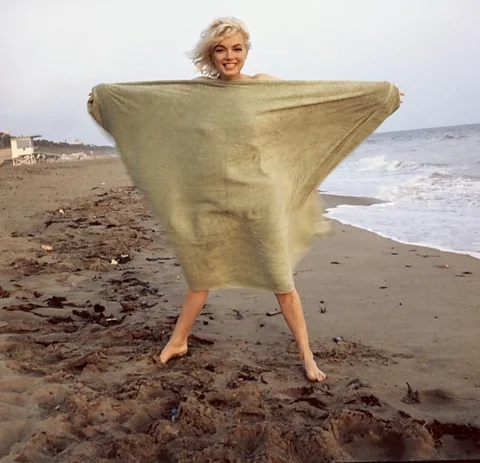 Photo: George Barris © INHOLLYWOODLAND.The George Barris Estate
The public’s fascination has continued to Monroe’s centenary; 1 June 2026 marks 100 years since her birth, and planned international events include a major new exhibition at London’s National Portrait Gallery (NPG), entitled Marilyn Monroe: A Portrait.
The NPG show, co-curated by Rosie Broadley and Georgia Atienza, is broadly chronological, encompassing famous images and fascinating contrasts (featuring photographers and artists such as Eve Arnold, Cecil Beaton and Andy Warhol), including six images from the Santa Monica shoot.
Broadley tells the BBC: “We thought about what seemed to be the most interesting and original approach to Marilyn Monroe, and one that maybe taught us more about Marilyn herself – and I say that with a lot of caution, because almost every time someone does something about Marilyn, they say that they’re going to reveal ‘the woman behind the image’, or ‘the truth behind the myth’. We approached her image-making by each of the most interesting collaborations; some went on for over a decade, like Philippe Halsman, some were just one shoot, but they became important to her.”
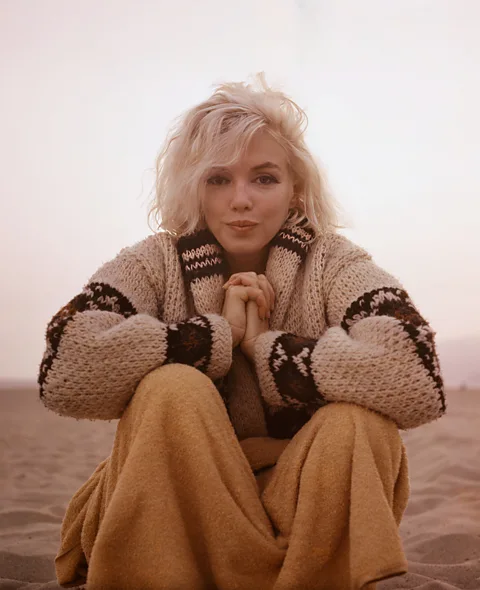 Photo: George Barris © INHOLLYWOODLAND.The George Barris Estate
“Through her journey with the different photographers she worked with, her image develops and evolves, and she became the person she was aiming to be, which is the big star, Marilyn Monroe. She uses these photographers in a really canny way.”
Under scrutiny
By 1962, Monroe was a global superstar facing personal and professional fall-outs; her third marriage (to playwright Arthur Miller) had ended; her body image was endlessly scrutinised (her famous curves were now considerably less following gall bladder surgery); her reputation for being “difficult” on set plagued her (though failing to show up or forgetting lines was arguably linked to her ill health, chronic insomnia, and addiction to prescription medication).
In June that year, Monroe was fired from the production Something’s Got to Give following repeated absences for sickness, and sued for damages by 20th Century Fox.
In response to the detractors and malicious rumour-mongers, Monroe undertook her own publicity campaign, including smart, stylish glossy magazine interviews in Vogue (featuring Bert Stern’s captivating series of photographs, also known as “The Last Sitting”) and Life (Allan Grant’s photos accompany her soul-bearing interview feature, Last Talk With a Lonely Girl, which was eerily published a couple of days before her death). Barris’s portraits had originally been intended for a Cosmopolitan article.
“She’s trying to raise her profile in a way, and rehabilitate her image,” says Atienza. “Often for her, the photo shoots were a way of dealing with a lot of the anxiety.”
Monroe and Barris had first met in 1954, on the set of The Seven Year Itch, and they had discussed creating a book about her life. There is a sense of rapport in their summer 1962 photos (which also included an indoor shoot), and a particular ease with the seaside setting.
Atienza describes the “naturalistic aesthetic” and Monroe’s “unburdened and spontaneous” demeanour in the Santa Monica photographs, and adds that the exhibition was curated through working closely with the photographers’ estates – including Barris’s daughter Caroline, who is the steward of his archive.
“Caroline Barris actually sent us loads of different ‘outtakes’ of that session, and you can really see [Monroe] having fun, just running, and almost dancing with the waves. That was quite poignant, knowing that these were the last images she did.”
Broadley points out that the California coast location would also have evoked happy memories for Monroe. There is a rare photo of the infant Monroe barefoot on the sand with her mother Gladys (who would later suffer a mental breakdown, leaving Monroe to be raised in foster care and orphanages); there is also a mid-1940s seaside photoshoot depicting Monroe as youthful, aspiring star, taken by André de Dienes. “The beach photos kind of bookend her life in a way that is really moving,” says Broadley.
Marilyn Monroe’s death
When Monroe’s untimely death was discovered, Cosmopolitan decided not to run Barris’s photos – instead, the Santa Monica portraits were snapped up by an agent for the UK newspaper The Daily Mirror, and they additionally appeared in British men’s lifestyle magazine Town in November 1962. The photos were also directly referenced in the Pop art of British painters Pauline Boty (Colour Her Gone, 1962) and Richard Hamilton (My Marilyn, 1965), both of which appear in the NPG collection.
“Many photographers focus on Monroe’s sexiness, but with Barris, it doesn’t feel like that,” says Broadley. “It feels like he’s just focusing on her playful spirit, and her. [Barris] was so convinced by that performance that he absolutely did not believe she killed herself.”
Shaken in the wake of Monroe’s death, Barris relocated to Paris for a couple of decades. When he eventually returned to the US, he published his portraits in a book collaboration with the feminist author and activist Gloria Steinem, entitled Marilyn (1986). Here, Steinem wrote: “in these [Santa Monica] photographs, the body emphasis seems more the habit of some former self. It’s her face we look at. Now that we know the end of the story, it’s the real woman we hope to find – looking out of the eyes of Marilyn.”
Barris would also revisit his conversations with and images of Monroe in his book Marilyn: In Her Own Words (1995). “We were trying to re-create various stages of her life in those pictures,” he wrote.
Source: BBC