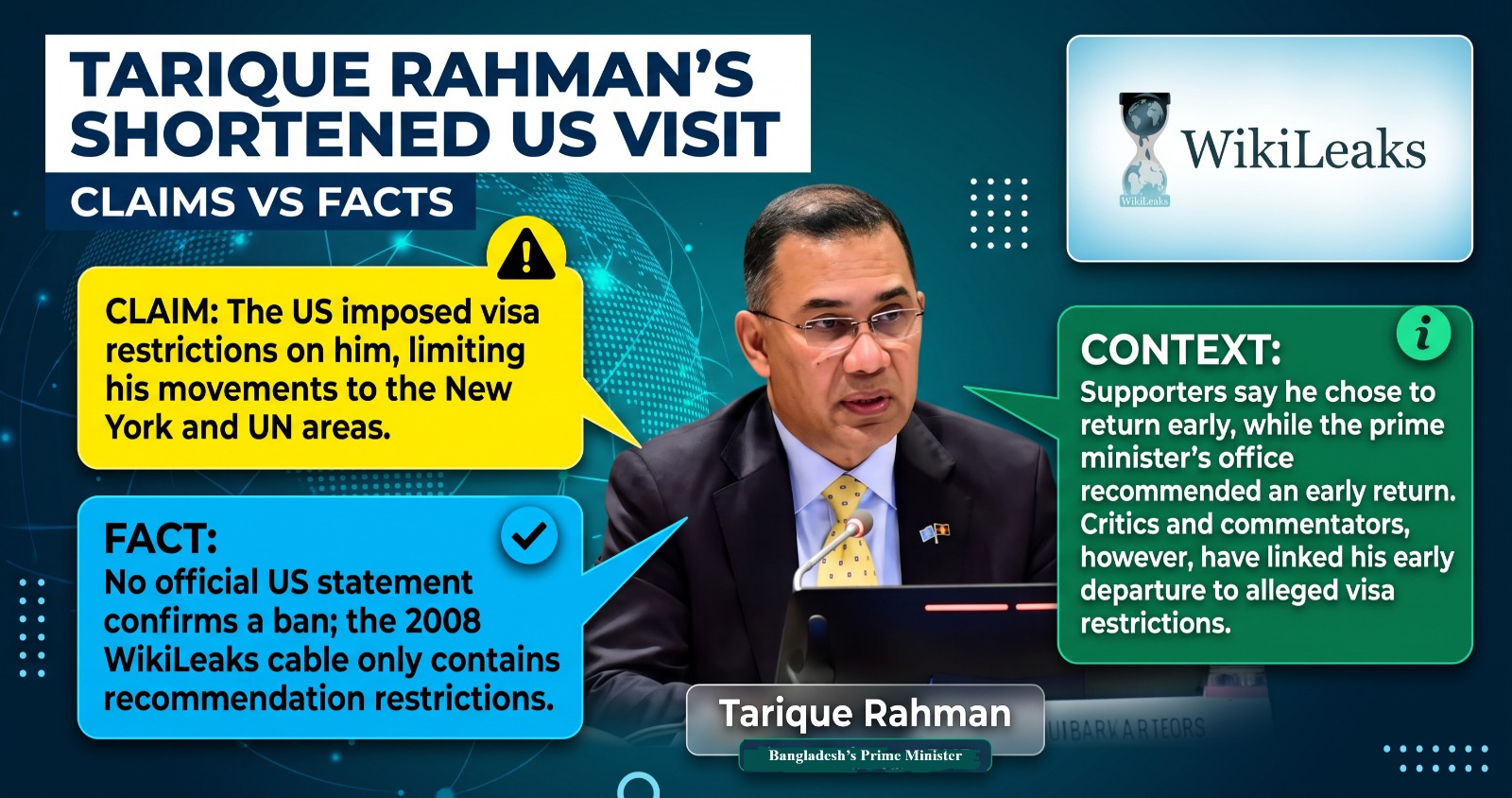
Special Correspondent: Prime Minister Tarique Rahman’s shortened visit to the United States has triggered a fresh political dispute in Bangladesh, with social media commentators claiming that the prime minister is subject to a US visa restriction that limits his movement outside New York and the United Nations area.
The allegation has been amplified by several commentators, including Nobonita, Arshad Mahmud and Masud Kamal. In video clips circulating online, they suggest that Rahman was required to remain within a limited radius of New York while attending the 81st session of the United Nations General Assembly.
But there is no publicly available US government confirmation that Rahman is currently subject to such a visa ban.
The controversy partly stems from a 2008 diplomatic cable released by WikiLeaks. The cable reportedly recorded a recommendation by the then US ambassador to Bangladesh, James F Moriarty, that Washington bar Rahman from entering the United States.
The recommendation, however, does not by itself establish that a ban was subsequently imposed. The US government has never publicly confirmed that the recommendation was accepted or that Rahman was placed under a formal visa restriction as a result.
The distinction is important because US visa restrictions and Treasury sanctions are often conflated in political discussions.
The Office of Foreign Assets Control, or OFAC, maintains public records of people and entities subject to US financial sanctions. Critics of the visa-ban claim point to the absence of Rahman’s name from the OFAC sanctions database as evidence that he is not under an official US sanction. But OFAC records are not, in themselves, a comprehensive database of US visa decisions, which are generally subject to confidentiality rules.
The debate has nevertheless intensified because Rahman’s visit to New York was shorter than some had expected. Political opponents and social media users have interpreted the decision as evidence that Washington imposed restrictions on his movements.
Supporters reject that interpretation, arguing that the prime minister deliberately shortened the trip because he considered returning to Bangladesh more important than extending his stay in the United States.
The controversy has also drawn comparisons with Narendra Modi, whose relationship with Washington provides a clearer public record.
In 2005, the then US ambassador to India, David Mulford, publicly confirmed that Modi’s application for a US diplomatic visa had been rejected. The decision was linked to a US determination concerning religious-freedom issues. Modi was later granted a US visa after becoming India’s prime minister.
Supporters of Rahman argue that the Modi precedent cannot simply be applied to his case because there is no comparable public statement from a US official confirming that Rahman’s visa application was rejected.
The dispute has also exposed tensions within Rahman’s own communications strategy.
Critics have questioned the prime minister’s press team for focusing on populist images of him travelling and eating alongside ordinary passengers rather than directly addressing the visa allegations. One widely circulated narrative portrayed Rahman as standing in line at an airport to buy a low-cost meal. Critics say such imagery is unnecessary and risks trivialising the prime minister’s official visit.
The wider political argument illustrates how quickly uncertainty surrounding diplomatic travel can become political ammunition.
For now, the central question remains unanswered: was Rahman’s shortened US visit the result of an American visa restriction, or was it simply a political decision to return home earlier?
Without an official statement from Washington or documentary evidence establishing a current restriction, claims of a US visa ban remain allegations rather than established fact.