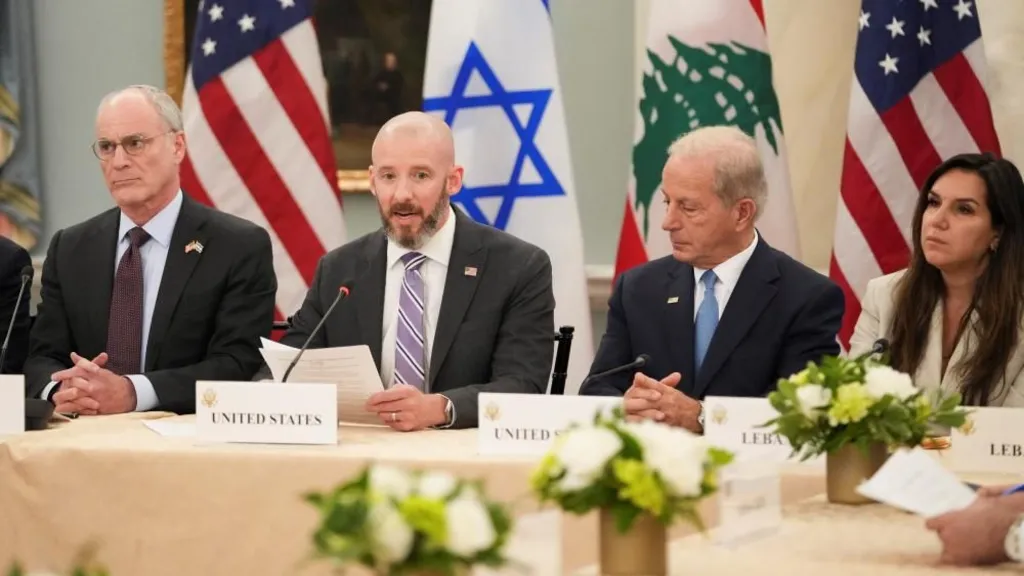
Israel and Lebanon have agreed to the implementation of a ceasefire, the US State Department has announced in a statement.
The agreement is “contingent on a complete cessation” of attacks from the Iran-backed armed group Hezbollah, among other conditions.
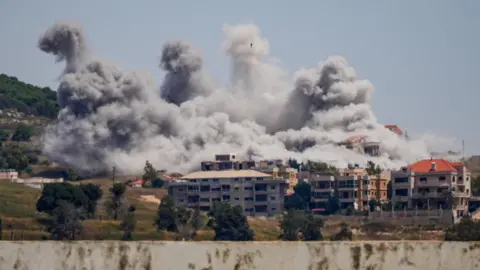
It comes after Israeli strikes killed at least nine people in southern Lebanon on Wednesday and Hezbollah fired rockets into northern Israel, testing a shaky truce initially agreed in April.
Meanwhile, overnight Israeli air strikes on apartments in Gaza City have killed at least nine people, with four children reported among the dead.
Iran’s Foreign Minister Abbas Araghchi said no progress has been made in talks with the United States, though channels of communication remain open.
Araghchi also defended Tehran’s attacks on US allies in the Gulf region as “self-defence” and warned: “What sanctions and war failed to achieve won’t be won with more war.”
“All countries reaffirmed that the future of the relationship between Israel and Lebanon must be decided by the two sovereign governments. They rejected any attempt, by any state or non-state actor, to hold Lebanon’s future hostage,” the statement said.
The agreement is also contingent on the “evacuation of all [Hezbollah] operatives” from an area Israel controls in southern Lebanon from the Litani river to the border.
The statement said the US would help guide the creation of “pilot zones in which the Lebanese Armed Forces will take exclusive control of the territory to the exclusion of all non-state actors”.
The announcement follows a partial ceasefire agreed on Monday, which Lebanon said would see Israel refrain from bombing Beirut, in exchange for Hezbollah not attacking Israel.
The two countries will meet again on 22 June to hold further talks “with a view toward reaching a comprehensive agreement”. Hezbollah has not yet commented publicly on the announcement.
US Secretary of State Marco Rubio told reporters before the announcement that he hoped they would produce “an action plan on a track for security in [Lebanon], independent from Hezbollah”.
The partial ceasefire was tested by both Israeli and Hezbollah fire this week.
Lebanon’s health ministry said those killed by Israel on Wednesday included two paramedics whose ambulance was hit in a strike in the southern Chehour area. A car was also struck just south of the capital Beirut.
Meanwhile, Israel’s military said it had intercepted a drone and two projectiles that crossed the border. Hezbollah said it targeted a gathering of Israeli troops.
Before the announcement on Wednesday evening, Israel’s leaders had warned that the country’s military would resume strikes on the Hezbollah stronghold in Beirut’s southern suburbs, known as Dahieh, if the group launched cross-border attacks on northern Israeli communities.
According to the Lebanese government, the partial ceasefire agreed on Monday stated that “Israel will not launch a broad offensive on Beirut in exchange for Hezbollah refraining from launching attacks against Israel”.
The government said Hezbollah had confirmed its acceptance, but a member of the group’s political council, Mahmoud Qamati, told the BBC on Tuesday: “There was no ceasefire agreement, just the protection of Dahieh.”
Qamati also insisted that Hezbollah would not abide by any commitments made at the Lebanese-Israeli talks in Washington.
“We think these negotiations do not concern us, nor do we recognise their findings or decisions, because we have rejected them on principle,” he said.
 Reuters
Lebanon was drawn into the war between the US, Israel and Iran on 2 March, when Hezbollah launched rockets into Israel in retaliation for an Israeli strike that killed Iran’s supreme leader. Israel responded with an air campaign across Lebanon and a ground invasion in the south.
Hezbollah is a Shia Muslim political and military group that operates in Lebanon and which has which has been involved in a series of violent conflicts with Israel. The group is considered a terrorist organisation by Israel and many other nations, including the UK and US.
A US-brokered ceasefire between Israel and Lebanon on 16 April failed to stop the fighting, and last week Prime Minister Benjamin Netanyahu ordered the Israeli military to intensify its strikes on Hezbollah and advance deeper into Lebanon in response to drone and rocket attacks on communities in northern Israel.
At least 3,516 people have been killed in Lebanon since the start of the war, according to the country’s health ministry. Its figures do not distinguish between combatants and civilians.
The UN says more than one million people have also registered themselves as displaced in Lebanon, where Israeli evacuation orders cover more than an eighth of the country.
Israel says 26 of its soldiers and four Israeli civilians have been killed on both sides of the border during the war.
Source: International news agencies and BBC