Special Correspondent
Bangladesh is now looking for foreign investors for a bank that did not even exist a year ago.
The government has started preliminary discussions with Qatar over a possible investment in the newly formed Combined Islami Bank, created by merging five troubled Islamic banks. Officials are also open to investors from other Muslim-majority countries.
The timing is striking. The government had decided to bring the new bank under state ownership after merging EXIM Bank, First Security Islami Bank, Global Islami Bank, Social Islami Bank and Union Bank. Now, barely nine months later, it wants to bring in private and foreign investors.
Why the change?
The answer is fairly straightforward: the financial hole inherited by the new bank is enormous.
The five banks had been in serious trouble before the merger. Bangladesh Bank data show that by the end of March, their combined non-performing loans had reached Tk165,779 crore—equivalent to 84.22% of their total loans.
That is not a minor balance-sheet problem. It is a banking crisis concentrated inside a single institution.
The government has put Tk20,000 crore into the new bank as part of its Tk35,000 crore paid-up capital. Another Tk15,000 crore is expected to come through the conversion of depositors’ claims into shares. The authorised capital stands at Tk40,000 crore.
The scale of the new institution is also considerable. It has 18,081 employees, 761 branches, 698 sub-branches, 511 agent-banking outlets and 975 ATMs.
So the government has effectively created a giant financial rescue vehicle—and is now looking for someone else to help drive it.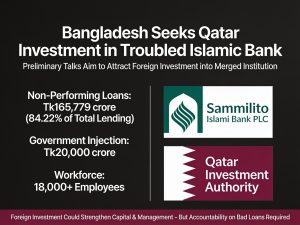
Qatar is an obvious place to look. The country has considerable financial resources and experience in international banking and investment. A serious foreign investor could bring fresh capital, stronger risk management and professional management to the troubled institution.
But there is a catch.
No sensible investor is likely to look only at the bank’s branches, employees and deposits. They will want to know what happened to the money.
Who received the enormous loans? Why did so many of them become non-performing? Were political connections involved? Were proper collateral and risk assessments followed? And, most importantly, who will ultimately absorb the losses?
These questions cannot simply disappear because a foreign investor arrives.
There is another concern. The government has acknowledged that a future private owner could restructure the bank’s workforce. With more than 18,000 employees, that could mean significant job losses. For workers who had assumed that state ownership meant greater security, the prospect of restructuring will be unsettling.
The government therefore needs to be careful about how it handles any ownership transfer. Taxpayers have already provided Tk20,000 crore. If the bank is eventually sold or opened to foreign investors, the process must be transparent, independently valued and commercially credible.
Otherwise, Bangladesh could end up with the worst of both worlds: the public absorbs the losses while a new investor gets the opportunity to acquire a cleaned-up institution at an attractive price.
The larger problem goes beyond this one bank.
Bangladesh’s banking sector has suffered for years from weak governance, politically influenced lending and inadequate risk management. Merging five troubled banks may prevent an immediate collapse, but it does not erase the reasons those banks became troubled in the first place.
Qatar may help rescue the new institution. But foreign money cannot substitute for accountability.
If Bangladesh wants this merger to become a genuine banking reform rather than another bailout, it needs three things above all: transparent ownership, independent management and accountability for the lending decisions that created the crisis.
Otherwise, the country will simply be changing the signboard while asking taxpayers to keep paying the bill.