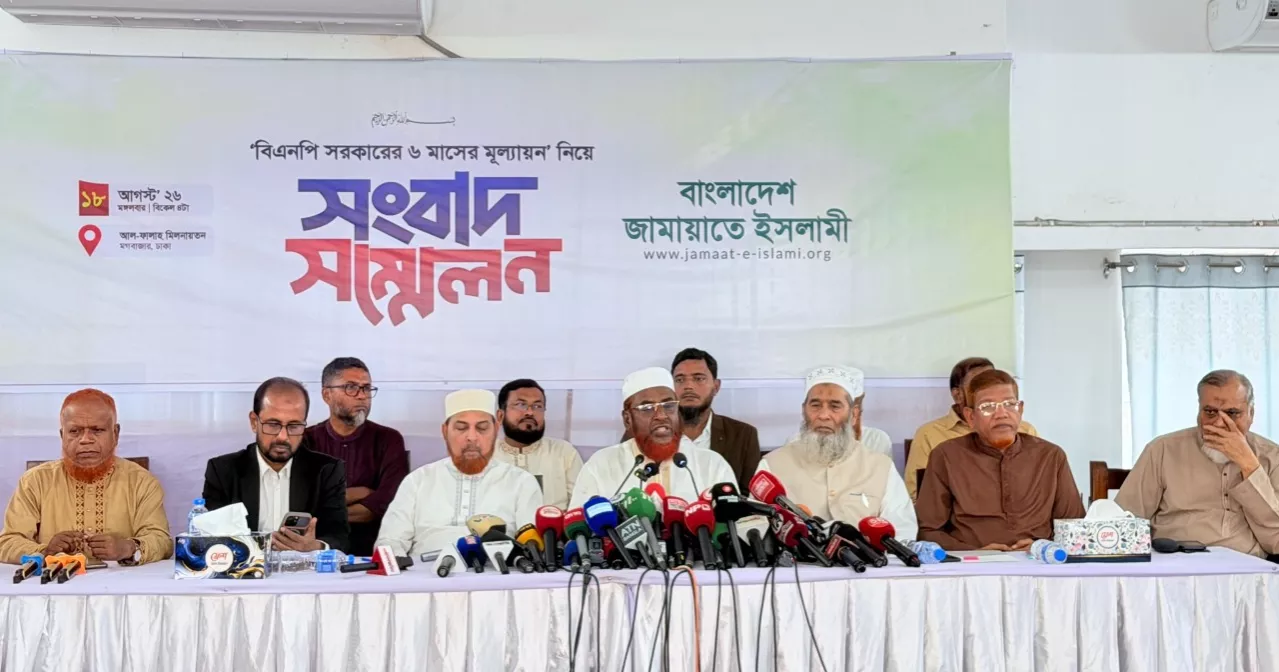
Dhaka: Bangladesh Jamaat-e-Islami on Tuesday claimed that the BNP government had failed completely in 12 key areas, including maintenance of law and order, the energy and banking sectors, controlling commodity prices, maintaining administrative neutrality and implementation of the referendum verdict, during the first six months of its tenure.
“In the first six months of the government’s tenure, we are presenting to the nation the utter failures of the government on all the issues that I have mentioned, including the public verdict of the referendum, the July Charter, law and order, energy security, commodity prices, administrative security, neutrality,” said Jamaat Secretary General Mia Golam Porwar.
He was addressing a press conference arranged at the Al-Falah Auditorium in the city’s Moghbazar to raise the first six-month failures and achievements of the current government, formed through the February 2026 general election.
The Jamaat leader, however, praised the government for the foreign exchange reserve situation and the ‘positive tendency’ displayed by accepting a proposal placed by the Opposition Leader to form a special parliamentary committee to solve the energy crisis a few months ago.
About the referendum, Porwar described the government’s negative role over the public verdict reflected in the referendum as the first failure of the government.
“The nation is now being pushed towards a conflict, and the dream of a new Bangladesh, achieved through a sea of blood in the July Mass Uprising, is about to end,” he said.
Regarding the energy crisis, the Jamaat Secretary General said the government failed to solve the gas, energy and electricity crisis.
He said the country’s daily gas demand was around 3,800 million cubic feet, against a combined domestic production and import supply of only 2,700-2,800 million cubic feet, leaving a daily shortfall of about 1,000 million cubic feet.
The crisis was affecting industries, power plants, CNG stations and other consumers, he said.
Porwar said gas production from 20 producing gas fields was around 1,630 million cubic feet per day in July, but the government had failed to make visible progress in increasing production to address the long-term crisis.
Raising another major failure, Porwar alleged that state-owned and government institutions and local government bodies were being used to rehabilitate leaders and activists of the ruling party.
He claimed that leaders and activists of the Chhatra Dal, Jubo Dal and BNP had been appointed to at least 11 government posts, autonomous corporations and positions in the Election Commission.
He also alleged that ruling party-affiliated people had been appointed to Zila Parishads, development authorities and city corporations.
“Merit, interviews and qualifications are not necessary for government appointments. A BNP party position has become a major qualification,” he said.
Regarding law and order, the Jamaat leader said the situation had deteriorated despite the government’s pledge to give the issue priority.
He cited figures that he attributed to Transparency International and other organisations, saying 605 murders, 294 robberies, 194 abductions and 3,416 incidents of violence against women and children were recorded during the first 100 days.
He alleged that the number of murders, robberies, abductions, thefts and incidents of violence against women and children had continued to rise. A number of 915 murders, 461 robberies, 286 abductions, 3277 thefts, 5,448 incidents of violence against women and children were recorded till May 2026, he added.
On foreign policy, Porwar said the government had failed to turn its declared “Bangladesh First” policy into a coordinated operational framework.
He also said there had been no visible progress on unresolved issues, including the extradition of former Prime Minister Sheikh Hasina.
On commodity prices, he said the rising cost of essentials was squeezing the purchasing power of general people. “Inflation has reached 9.16 percent, food inflation 8.69 percent and non-food inflation 9.61 percent,” he said.
The Jamaat leader said the cost of food, housing, transportation and other essentials was putting increasing pressure on the incomes of lower- and middle-income families.
He also criticised the government over the banking sector, saying non-performing loans had reached Tk 5,88,704 crore at the end of March, accounting for 32.26 percent of total loans.
He said defaulted loans had increased by Tk 31,427 crore in just three months, while there had been no visible progress in resolving liquidity problems in weak banks, restoring depositors’ confidence or easing pressure from high interest rates.
Porwar also alleged that government intervention in Islami Bank had contributed to instability in the banking sector.
He also criticised the government for allowing the enforced disappearance and human rights related ordinances to lapse, its poor performances in education, agriculture particularly for the fertiliser crisis, judiciary and health sectors.
Jamaat leaders AHM Hamidur Rahman Azad, Abul Hasnat Mohammad Abdul Halim, Matiur Rahman Akanda and Shafiqul Islam Masud, among others, were present.